
Newsletter Vol. 30 - China IP Updates (2025-2026)
Download PDF Version↓
Shangcheng Newsletter(EN) Vol. 30
Comparison of punitive damages interpretation 2026 VS 2021

<China IP News>
- ● SPC and CNIPA Release 2025 Intellectual Property Protection Statistics
- ● SPC Releases Ten Representative Intellectual Property Cases for 2025
- ● New Judicial Interpretation on IP Punitive Damages
<China IP News>
- ● SPC and CNIPA Release 2025 Intellectual Property Protection Statistics
Each year around April 26 (World Intellectual Property Day), the Supreme People's Court (SPC) and the China National Intellectual Property Administration (CNIPA) respectively release statistics on intellectual property (IP) protection for the preceding year.
This year, the SPC published Status of Judicial Protection of Intellectual Property Rights by Chinese Courts (2025) on April 20, followed by CNIPA’s release of Status of Intellectual Property Protection in China (2025) on May 7. Drawing on these reports, we summarize the key figures and trends in China's IP enforcement landscape, covering both judicial and administrative protection mechanisms.
- Intellectual Property Protection through the Judicial Route
(1) Civil Litigation Statistics
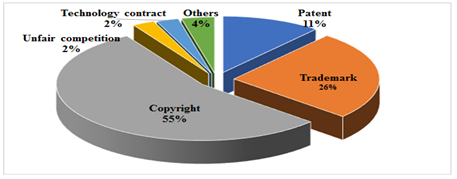
Chinese courts accepted 473,411 new first-instance civil IP cases in 2025, representing a 5.22% year-on-year increase. Copyright disputes continued to dominate the civil IP docket, with 259,248 newly accepted cases, accounting for 54.76% of the total. Trademark cases ranked second at 121,133 cases (25.59%), followed by patent disputes at 52,177 cases (11.02%), technology contract disputes at 11,782 cases (2.49%), unfair competition cases at 11,684 cases (2.47%), and other IP-related cases at 17,387 cases (3.67%) (See Tables 1, 2, and 3). Among these categories, trademark litigation was the only area to record a decline, with newly accepted cases decreasing by 3.03%. It should be noted that patent cases include cases involving invention patents, utility model patents, and design patents.
At the appellate level, the total number of second-instance civil IP cases was 24,515, a decrease of 19.59% compared with the previous year. As shown in Table 1, the number of second-instance cases has shown a consistent downward trend since 2021.
Table 1. Number of Civil IP Cases Accepted by People's Courts (2021–2025)
|
Instance/Category |
2021 |
2022 |
2023 |
2024 |
2025 |
YoY Change |
|
|
Civil First-Instance |
550,263 |
438,480 |
462,173 |
449,923 |
473,411 |
5.22% |
|
|
Category |
Patent |
31,618 |
38,970 |
44,711 |
44,255 |
52,177 |
17.90% |
|
Trademark |
124,716 |
112,474 |
131,429 |
124,918 |
121,133 |
-3.03% |
|
|
Copyright |
360,489 |
255,693 |
251,687 |
247,149 |
259,248 |
4.90% |
|
|
Unfair competition |
8,419 |
9,388 |
10,230 |
10,567 |
11,684 |
10.57% |
|
|
Technology contract |
4,015 |
4,233 |
6,492 |
8,320 |
11,782 |
41.61% |
|
|
Others |
21,006 |
17,717 |
17,627 |
14,714 |
17,398 |
18.17% |
|
|
Civil Second-Instance |
49,084 |
46,524 |
37,214 |
30,486 |
24,515 |
-19.59% |
|
Table 2. Trend in First-Instance Civil IP Cases Accepted (2021–2025)
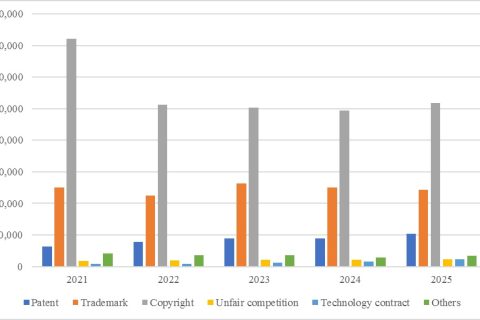
Table 3. Breakdown of First-Instance Civil IP Cases by Category (2025)
(2) Administrative Litigation Statistics
Chinese courts accepted a total of 27,451 new first-instance administrative IP cases in 2025, marking a year-on-year increase of 31.67%. Trademark cases remained the largest category, with 24,334 cases, accounting for 88.65% of all newly accepted cases. Patent cases totaled 3,070, representing 11.18%. Copyright administrative cases increased by 200% to 27 cases, while other types of administrative IP cases decreased by 35.48% to 20 cases.
Meanwhile, the total number of newly accepted second-instance administrative IP cases was 11,097, representing a year-on-year decrease of 4.88% (see Tables 4 and 5).
Table 4. Number of Administrative IP Cases Accepted by People's Courts (2021–2025)
|
Instance/Category |
2021 |
2022 |
2023 |
2024 |
2025 |
YoY Change |
|
|
Administrative First-Instance |
20,563 |
20,634 |
20,583 |
20,849 |
27,451 |
31.67% |
|
|
Category |
Patent |
1,810 |
1,876 |
1,990 |
1,679 |
3,070 |
82.85% |
|
Trademark |
18,734 |
18,738 |
18,558 |
19,130 |
24,334 |
27.20% |
|
|
Copyright |
19 |
12 |
11 |
9 |
27 |
200% |
|
|
Others |
0 |
8 |
24 |
31 |
20 |
-35.48% |
|
|
Administrative Second-Instance |
8,215 |
5,897 |
10,053 |
11,666 |
11,097 |
-4.88% |
|
Table 5. Trend in First-Instance Administrative IP Cases Accepted (2021–2025)
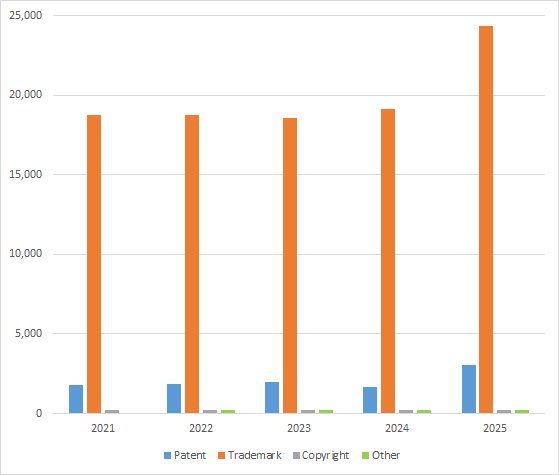
(3) Criminal Litigation Statistics
Chinese courts accepted 9,018 new first-instance criminal IP cases in 2025, a decrease of 1.12% compared with the previous year. Among the major categories, trademark cases declined by 2.69% to 7,862 cases, while other criminal IP cases, including patent cases, decreased by 17.65% to 85 cases. In contrast, copyright criminal cases recorded a significant increase of 14.18% to 1,071 cases. At the appellate level, the number of second-instance criminal IP cases was 1,153, representing a year-on-year increase of 3.69%.
Table 6. Number of Criminal IP Cases Accepted by People's Courts (2021–2025)
|
Instance/Category |
2021 |
2022 |
2023 |
2024 |
2025 |
YoY Change |
|
|
Criminal First-Instance |
6,276 |
5,336 |
7,335 |
9,120 |
9,018 |
-1.12% |
|
|
Category |
Trademark |
5,869 |
4,971 |
6,634 |
8,079 |
7,862 |
-2.69% |
|
Copyright |
333 |
304 |
627 |
938 |
1,071 |
14.18% |
|
|
Others |
74 |
61 |
74 |
103 |
85 |
-17.65% |
|
|
Criminal Second-Instance |
1,050 |
979 |
956 |
1,112 |
1,153 |
3.69% |
|
Table 7. Trend in First-Instance Criminal IP Cases Accepted Courts (2021–2025)
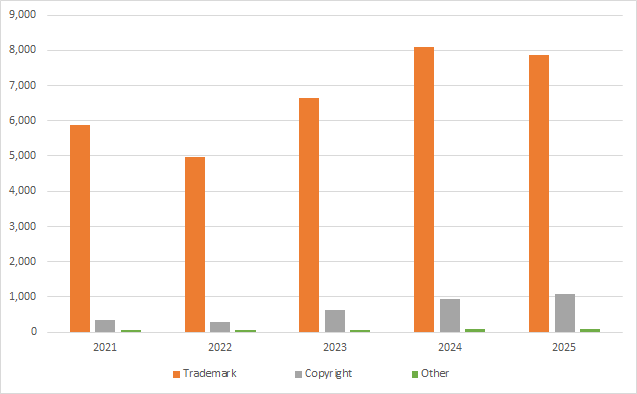
- Intellectual Property Protection through the Administrative Route
(1) Enforcement of Patent Rights via Administrative Route
In 2025, Market Regulation Administration nationwide investigated and handled 881 patent-related violations. As part of nationwide campaigns against infringing and counterfeit goods, products valued at RMB 432 million were destroyed, covering over 200 product categories and totaling 3,683 tons.
In addition, Intellectual Property Administration nationwide accepted 9,520 patent infringement disputes and concluded 9,341 cases during the year.
(2) Enforcement of Trademark Rights via Administrative Route
In 2025, Market Regulation Administration nationwide investigated approximately 36,000 trademark-related violations. Among these, 1,128 cases involving suspected criminal conduct were referred to judicial authorities for criminal prosecution.
- Observations
The 2025 statistics reveal growth in first-instance civil and administrative IP cases and a decline in first-instance criminal IP cases over the past year. In addition, 59 bad-faith agencies and practitioners were placed on the list of entities committing serious illegal violations, reflecting continued efforts to strengthen enforcement against unlawful and improper agency practices.
A review of the five-year litigation trend shows a steady increase in first-instance cases involving unfair competition and technology contract disputes since 2021. This trend reflects a rise in unfair competition and trade secret infringement activities. In response, legislative and judicial measures have been strengthened, including amendments to China's Anti-Unfair Competition Law in 2025.
At the same time, administrative enforcement against IP infringement continues to intensify. In particular, serious trademark-related violations that may constitute criminal offenses are increasingly being transferred to judicial bodies for criminal prosecution following initial administrative investigation and enforcement.
For rights holders, these developments underscore the importance of adopting a multi-faceted enforcement strategy. Beyond judicial remedies, rights holders should leverage the distinctive advantages of administrative enforcement and, where appropriate, consider criminal enforcement under the Criminal Law.
- ● SPC Releases Ten Representative Intellectual Property Cases for 2025
On April 20, 2025, the Supreme People's Court of China released its annual representative intellectual property (IP) cases for 2025.
Each year, around the World Intellectual Property Day (April 26), the Supreme People's Court publishes a selection of representative IP cases concluded in the preceding year. The 2025 list comprises ten cases, including one administrative case, one criminal case, seven civil cases, and one criminal case with an incidental civil action. In terms of the types of rights involved, the selected cases include one patent case, four trademark cases, one copyright case, and five unfair competition cases (with some overlap among categories). As in the previous year, unfair competition disputes accounted for a significant portion of the selected cases.
Patents
One civil case involving the application of the doctrine of equivalents in the field of power management integrated circuits was selected (Case 2, discussed below).
Trademarks
The selected cases include: an administrative case concerning the registrability of a phrase trademark (Case 1); a civil case in which punitive damages were awarded against a business operator that manufactured and sold refurbished products made from recovered used goods bearing another party's trademark, in addition to having been subjected to criminal penalties; and a coordinated civil-criminal case involving the manufacture and sale of counterfeit products, in which the defendant was held civilly liable and prosecuted criminally.
Copyright
One case addressing the liability of an e-commerce platform operator that facilitated the sale of pirated e-books was selected.
Unfair Competition
The selected cases covered a broad spectrum of misconduct, including: a criminal case involving the misappropriation of technical trade secrets by a former employee; a civil case concerning the poaching of employees from a competitor through circumvention of non-compete obligations; a civil case involving the sale of data obtained through improper web scraping from Taobao and Tmall; a civil case concerning defamatory statements made about a competitor and its management on social media platforms; and a civil case in which repeated filings of trademark applications similar to another party's trademark were held to constitute unfair competition (Case 10).
As in the previous year, no cases relating to new plant varieties or antitrust law were included in the list.
In addition, representative cases frequently include disputes involving foreign enterprises. This year was no exception: Case 1 involved the U.K. fragrance company Penhaligon's, while Case 2 involved the Chinese subsidiary of the U.S. semiconductor company Monolithic Power Systems (MPS).
Overall, the 2025 selection appears to place greater emphasis on demonstrating the courts' firm stance against malicious infringement and misconduct warranting criminal sanctions, rather than on addressing complex legal issues. With respect to online unfair competition-related disputes, the selected cases differed from many of those featured in the 2024 list, which often involved emerging technologies. Instead, the 2025 cases focused largely on more traditional forms of misconduct, such as the misappropriation of trade secret by former employees and dissemination of disparaging statements about competitors through online videos.
The following sections summarize three of the ten representative cases that are relevant to patents and trademarks: Cases 1, 2, and 10.
- Case 1: Trademark Rejection Appeal Concerning the Mark “乔治勋爵的悲剧 (The Tragedy of Lord George)”[i]
This case is an administrative lawsuit seeking judicial review of a TRAB decision dismissing an appeal against a trademark refusal. It is a representative case addressing the distinctiveness of phrase marks.
The plaintiff, PENHALIGON'S LIMITED ("Penhaligon's"), a U.K. company, filed a trademark application on June 24, 2021, seeking registration of the mark “乔治勋爵的悲剧” (“The Tragedy of Lord George”) for perfume and other goods in Class 3. In the fragrance industry, a number of similarly styled phrase marks had already been registered, including “蓬帕杜夫人的茶杯(Madame de Pompadour's Teacup)”, “花花公主的秘密(The Secret of Princess Flower)”, “莎菲女士的日记(The Diary of Lady Safi)” and “奥德利夫人的秘密(The Secret of Lady Audley)”. Since 2020, Penhaligon's had marketed and sold perfumes under the “乔治勋爵的悲剧” brand in China.
The China National Intellectual Property Administration (CNIPA) examined the application and found that the mark consisted of a phrase and was unlikely to function as a badge of origin for the relevant goods. CNIPA therefore held that the mark lacked distinctiveness under Article 11(1)(iii) of the Trademark Law and rejected the application. Both the first-instance and second-instance courts upheld the refusal. Penhaligon's subsequently petitioned the Supreme People's Court for a retrial.
The Supreme People's Court reached a different conclusion. The Court found that the phrase was not a common expression or ordinary wording used in everyday language. Rather, its composition, meaning, and pronunciation possessed a certain degree of originality. In addition, none of the constituent elements constituted generic or customary terminology within the perfume industry. The Court further held that the phrase did not function as an advertising slogan or descriptive expression and bore no relationship to the functions, uses, or other characteristics of the designated goods. Taking into account the trademark registration practices within the relevant industry, as well as the mark's actual use in the marketplace, the Court ultimately overturned both lower-court judgments and the challenged refusal decision.
This decision provides important guidance regarding the assessment of distinctiveness for phrase-based trademarks and offers several practical lessons for brand owners:
(1) Emphasize originality when creating brand names. Applicants should avoid commonly used expressions within the relevant industry as much as possible. However, applicants should not hesitate to seek registration of creative phrase trademarks.
(2) Maintain evidence of use. Evidence demonstrating actual market use can play a significant role in supporting trademark registration. However, applicants should exercise caution when using signs that may raise concerns under Article 10 of the Trademark Law.
(3) Leverage comparable registrations. Prior registrations within the same industry may serve as persuasive evidence in administrative review proceedings and subsequent trademark litigation.
- Case 2: Patent Infringement Dispute Involving a Power Management IC[ii]
This case concerns the application of the doctrine of equivalents in assessing patent infringement involving a power management integrated circuit (PMIC).
The plaintiff, Chengdu Monolithic Power Systems Co., Ltd., is the Chinese subsidiary of Monolithic Power Systems, Inc. (MPS), a globally competitive U.S. fabless semiconductor company, and owns a patent entitled “Control circuit for synchronous rectifier and the method thereof.”
In September 2020, the plaintiff filed a patent infringement lawsuit against a Shenzhen-based technology company, alleging that the defendant's PMIC infringed its patent. The plaintiff sought an order requiring the defendant to cease the infringing activities and to pay RMB 10 million in damages.
The Chengdu Intermediate People’s Court, acting as the court of first instance, found that the defendant's circuit module constituted an equivalent feature to the pulse signal generation function recited in Claim 1 of the asserted patent. The court therefore held that the defendant had infringed the patent and ordered it to cease the infringing activities and pay damages of RMB 1.2 million. The defendant was dissatisfied with the judgment and filed an appeal.
On appeal, the Supreme People's Court emphasized that, when construing patent claims in the field of electrical engineering involving logic circuits, emphasis should be placed on understanding the logical connections among the technical features, the direction of signal flow, and control timing. Technical features should not be interpreted in isolation, detached from the logical chain in which they are situated. The Court further stated that the pulse signal generation recited in the asserted claim should be interpreted from the perspective of a person skilled in the art, taking into account the invention as a whole as reflected in the claim, together with the specification, drawings, common general knowledge in the relevant technical field, and the specific feature recited in the claim. Applying these principles, the Court concluded that the defendant's circuit module differed from the pulse signal generation feature of Claim 1 of the patent in suit in terms of its means, function, and effect, and therefore did not constitute an equivalent feature. Accordingly, the court reversed the first-instance judgment.
The parties had been engaged in parallel patent infringement and trade secret litigation in the United States since 2020. Following the settlement of the U.S. litigation, the issuance of this judgment in China attracted considerable attention for bringing a five-year global dispute between the parties to a close.
In selecting this case as one of the representative IP cases of 2025, the Supreme People's Court commented that: "This judgment clarifies the key considerations governing patent claim construction and the assessment of infringement under the doctrine of equivalents in the relevant technical field. It provides a valuable judicial reference for similar disputes and represents a meaningful effort to strike an appropriate balance between safeguarding the public interest and fostering innovation."
- Case 10: Unfair Competition Case Involving Trademark Filings Related to “蓝妹”(Blue Girl) Beer[iii]
This case is a representative example of the coordinated application of China's Trademark Law and Anti-Unfair Competition Law to curb persistent and repetitive bad-faith trademark filings.
The plaintiff, Blue Girl Beer (Guangzhou) Co., Ltd. (“Blue Girl Beer”), is a joint venture established by Budweiser Group and Jebsen Group, both leading enterprises in the beer industry. Blue Girl Beer markets premium beer under the "Blue Girl" brand, particularly in Hong Kong and Guangdong Province, and owns the “蓝妹” (Blue Girl) series of trademarks, which enjoy a certain degree of market recognition and reputation.
The defendant, a Guangdong-based trading company also engaged in the beer business, repeatedly instructed a Guangzhou trademark agency to file more than a dozen trademark applications incorporating signs similar to “蓝妹”, including “蓝味啤酒” (“Blue Taste Beer”), which has a similar pronunciation to “蓝妹” in Chinese, and “蓝魅啤酒” (“Blue Charm Beer”), which is pronounced identically or similarly to “蓝妹” (Blue Girl). Two of those marks were subsequently licensed to third parties. The trademark agency that handled the filings was named as a co-defendant in the proceedings.
Prior administrative decisions and court judgments had already determined that the above marks filed by the defendant were similar to the plaintiff's “蓝妹” (Blue Girl) series of trademarks. The authorities further found that the defendant company had intentionally copied and imitated another party’s well-known trademark and sought registration through improper means. As a result, all of the disputed trademark applications were ultimately refused, rejected or invalidated.
Blue Girl Beer subsequently brought an unfair competition lawsuit, alleging that the defendant company's repeated bad-faith trademark filings and the trademark agency's assistance in facilitating those filings constituted unfair competition. The plaintiff sought orders requiring both defendants to cease the alleged unfair competition, RMB 1 million in damages and reasonable expenses from the defendant company and joint liability of RMB 250,000 from the trademark agency.
In the first-instance judgment, the Yuexiu District People's Court of Guangzhou held that the defendant company’s continuous and repeated filing of trademark applications similar to the “蓝妹” (Blue Girl) series trademarks, while being aware of those marks, clearly exceeded the needs of normal production and business operations, had the purpose of free-riding on Blue Girl Beer’s goodwill and seeking improper gains, and therefore constituted bad-faith trademark registration conduct. Moreover, licensing two of the disputed trademarks to third parties constituted trademark stockpiling for profit, reinforcing the unfair nature of the conduct. As for the trademark agency, the court held that it had knowingly assisted in the defendant company's bad-faith filing strategy and therefore constituted contributory infringement. As a result, the court ordered the defendant company to pay RMB 500,000 in damages and the trademark agency jointly liable for up to RMB 100,000. On appeal by the trademark agency, the Guangzhou Intellectual Property Court dismissed the appeal and upheld the first-instance judgment.
This judgment takes a firm stance against the large-scale and repetitive trademark filings, even where an earlier court decision had already determined that the registrations were made in bad faith. The court held that trademark hoarding beyond legitimate business needs, carried out in bad faith and for the purpose of free-riding on another party’s goodwill, may constitute unfair competition and fall within the scope of unfair competition regulation. In doing so, the decision establishes a coordinated framework between administrative trademark regulation and civil judicial remedies in addressing bad-faith trademark filings. It opens a new avenue of protection for trademark owners by confirming that, while administrative procedures may be used to prevent or invalidate the registration of bad-faith marks, civil litigation may simultaneously provide a basis for seeking damages. As such, the judgment represents a significant development in the enforcement toolkit available to rights holders confronting bad-faith trademark practices.
ⅰ Case No. (2025) SPC Administrative Retrial No. 200
ⅱ Case No. (2023) SPC IP Civil Final No. 2903
ⅲ Case No. (2025) Guangdong IP Court Civil Final No. 656
- ● New Judicial Interpretation on IP Punitive Damages
- On April 20, 2026, the Supreme People’s Court of China issued the Interpretation on the Application of Punitive Damages in the Trial of Civil Disputes over Intellectual Property Infringement (the “Judicial Interpretation”), which will take effect on May 1, 2026.
Punitive damages for IP infringement are separately provided for under the Patent Law, the Trademark Law, the Anti-Unfair Competition Law, and the Copyright Law. For example, Article 71(1) of the Patent Law states:
“The amount of compensation for patent right infringement shall be determined on the basis of the actual losses suffered by the right holder as a result of the infringement or the profits earned by the infringer as a result of the infringement. Where it is difficult to determine the losses suffered by the right holder or the profits earned by the infringer, the amount shall be reasonably determined by reference to the multiple of the amount of the royalties for the patent license. For intentional infringement of a patent right, if the circumstances are serious, the amount of compensation may be determined at not less than one time and not more than five times the amount determined in accordance with the above‑mentioned method.”
The Supreme People’s Court previously issued a judicial interpretation on the application of punitive damages in 2021. The newly issued Judicial Interpretation revises and supplements the 2021 version. The principal revisions include: (i) clarifying that where a plaintiff fails to claim punitive damages in the original infringement lawsuit, a separate subsequent lawsuit seeking such damages after the conclusion of the infringement proceedings will not be accepted; (ii) expanding the circumstances that may constitute “willful infringement” and “serious circumstances” — the two prerequisites for applying punitive damages; and (iii) further clarifying the methods for determining both the calculation basis and the multiplier for punitive damages.
Below is an overview of the newly issued Judicial Interpretation compared with the 2021 interpretation. Please also refer to the attached English translation of the comparison table setting out the differences between the new and prior judicial interpretations on punitive damages.
(1) Requirements for Claiming Punitive Damages (Articles 1–5)
As under the previous framework, the application of punitive damages requires an express claim by the plaintiff. The plaintiff must specifically state the amount of punitive damages sought, the method of calculation, and the factual and legal grounds supporting the claim. A plaintiff may add a claim for punitive damages before the end of the debate in the court of first instance. However, where such a claim is added during the second‑instance proceedings, the court may only conduct voluntary mediation; if mediation fails, the claim will not be upheld.
The Judicial Interpretation further clarifies that if a plaintiff in an infringement lawsuit claims ordinary damages but not punitive damages, and still fails to do so after the court has provided clarification, the court will not accept a subsequent separate lawsuit seeking punitive damages based on the same infringement facts after the original proceedings have concluded.
In addition, the Judicial Interpretation provides that claims for punitive damages in unfair competition cases other than trade secret infringement will generally not be supported unless otherwise expressly provided by law.
(2) Criteria for Determining “Willful Infringement” (Article 6)
As noted, Article 71(1) of the Patent Law imposes two requirements for the application of punitive damages: “willful infringement” and “serious circumstances.”
With respect to determining “willful infringement,” the new Judicial Interpretation retains the requirement that courts comprehensively consider factors such as the type of intellectual property right at issue, the status and recognition of that right, and the relationship between the defendant and the plaintiff or interested parties.
The newly issued Judicial Interpretation revises and supplements certain circumstances that may constitute “willful infringement.” The following scenarios remain substantially unchanged from the 2021 interpretation:
(i) the defendant continues the infringing conduct after receiving notice from the plaintiff or an interested party;
(ii) the defendant or its legal representative or manager is also the legal representative, manager, or actual controller of the plaintiff or an interested party;
(iii) an employment, labor service, cooperation, licensing, distribution, agency, or representative relationship exists with the plaintiff or an interested party, and the defendant had access to the intellectual property right at issue;
(iv) the defendant has a business relationship or contract negotiations with the plaintiff or an interested party, and had access to the intellectual property right at issue; and
(viii) other circumstances that may be considered willful.
Under the new Judicial Interpretation, item (ii) has been further clarified to expressly require that the defendant knew or should have known of the intellectual property right at issue. In addition, while the previous interpretation referred to “engaging in piracy or counterfeiting registered trademarks,” the new Judicial Interpretation newly adds “counterfeiting others’ patents” as a circumstance constituting willful infringement.
Furthermore, the following additional circumstances have been introduced:
(vi) the defendant, after reaching a settlement with the plaintiff and agreeing to cease the infringing conduct, commits the same or similar infringing conduct again; and
(vii) the defendant conceals the actual controlling relationship by establishing affiliated companies, changing the legal representative or controlling shareholder, operating through nominee companies, or other means, or signs liability waivers in order to evade legal liability for infringing the intellectual property rights at issue.
(3) Criteria for Determining “Serious Circumstances” (Article 7)
The criteria for determining “serious circumstances” have also been revised.
Previously, to determine “serious circumstances,” courts were required to comprehensively consider factors such as the means of infringement, frequency of infringement, duration, geographic scope, scale, consequences of the infringing conduct, and the infringer’s conduct during the litigation process. Under the new Judicial Interpretation, the factor of “the infringer’s conduct during litigation” has been replaced with “the infringer’s awareness of and basic attitude towards the infringement.” This revision is intended to replace the previous abstract wording with a more concrete and understandable standard.
The circumstances that may constitute “serious circumstances” have also been adjusted. The following circumstances remain substantially unchanged from the 2021 interpretation:
(i) the infringer commits the same or similar infringing act after having been administratively punished or held legally liable by a court judgment for the infringement;
(ii) the infringer refuses to fulfill a preservation order without justifiable reason;
(iii) the infringer forges, destroys, or conceals evidence relating to the infringement; and
(vii) other circumstances that should be considered as serious.
The new Judicial Interpretation further refines the previously existing provision regarding “engaging in intellectual property infringement as a business” by clarifying that this includes situations “(iv) where the infringing conduct constitutes the infringer’s principal business activity, or profits derived from infringement constitute the principal source of income.”
Meanwhile, the former provision referring to “(v) where the infringer makes enormous profits from the infringement or causes substantial damage to the right holder” has been revised to “(v) where the infringer makes enormous profits from the infringement or causes serious damage to the right holder’s goodwill, market share, etc.”
In addition, the previous provision concerning “(vi) where the defendant endangers national security, public interests or personal health with the infringing conduct” has been revised to refer to situations “(vi) where the infringing conduct endangers or could endanger national interests or the social public interest.”
(4) Clarification of the Method for Calculating the Base Amount (Articles 8–10)
As provided in the latter part of Article 71(1) of the Patent Law, punitive damages are determined in an amount of one to five times the compensatory damages calculated under ordinary methods. In practice, the amount of damages calculated under ordinary methods is generally treated as the “base amount,” and punitive damages are then calculated according to the formula: base amount × multiplier.
In determining this base amount, the court may order the defendant to produce relevant documents, including account books and other materials relating to the infringing acts. Where the defendant refuses to do so without justifiable reason or submits false account books or materials, the People’s Court may determine the base amount based on the plaintiff’s claims and the evidence available in the case.
The new Judicial Interpretation further clarifies that statutory damages determined by the court based on the circumstances of the case — where neither the right holder’s losses, the infringer’s profits, nor a reasonable royalty amount can be determined — may not serve as the base amount for calculating punitive damages. Although this approach had already been adopted in judicial practice, it was not expressly provided for in the 2021 interpretation.
The new Judicial Interpretation also clarifies that:
- where the defendant’s illegal income or profits from infringement are used as the base amount, the amount may be determined by reference to the defendant’s operating profits;
- where the defendant engages in IP infringement as a business, the base amount may be determined by reference to the defendant’s sales profits; and
- where the applicable profit margin cannot be determined, the court may refer to the average profit margin in the same industry during the same period published by statistical authorities or industry associations, or to the profit margin of the right holder.
(5) Clarification of the Method for Determining the Multiplier (Articles 11–13)
As before, the multiplier used to calculate punitive damages is determined by comprehensively considering factors such as the degree of the defendant’s subjective fault and the seriousness of the infringing act. The new Judicial Interpretation expressly provides that the multiplier need not be an integer, so long as it falls within the statutory range of one to five times.
The Judicial Interpretation also clarifies that the total amount of damages determined through the application of punitive damages may not exceed five times the base amount, and that reasonable expenses paid by the right holder to stop the infringement are to be calculated separately in addition to the total amount. In this regard, some prior judicial decisions and local court guidelines had treated the total amount of punitive damages as the sum of: (i) compensatory damages constituting the base amount, and (ii) punitive damages calculated by multiplying the base amount by a specified multiplier (see, e.g., Judgment No. (2021) Zhe Min Zhong 294). Under that approach, total recovery could effectively amount to ordinary damages plus one to five times that amount, resulting in a maximum of up to six times the ordinary damages. The new Judicial Interpretation expressly clarifies that such an approach is incorrect, and that the maximum total recovery is capped at five times the ordinary damages.
Furthermore, the Judicial Interpretation provides that where a fine or a penalty has already been imposed and fully enforced for the same infringing act, the court shall take such circumstance into account when determining the multiplier for punitive damages, even if the defendant does not specifically request consideration of this factor.