
SPC and CNIPA Release 2025 Intellectual Property Protection Statistics
- Download PDF Version↓
- SPC and CNIPA Release 2025 Intellectual Property Protection Statistics
Each year around April 26 (World Intellectual Property Day), the Supreme People's Court (SPC) and the China National Intellectual Property Administration (CNIPA) respectively release statistics on intellectual property (IP) protection for the preceding year.
This year, the SPC published Status of Judicial Protection of Intellectual Property Rights by Chinese Courts (2025) on April 20, followed by CNIPA’s release of Status of Intellectual Property Protection in China (2025) on May 7. Drawing on these reports, we summarize the key figures and trends in China's IP enforcement landscape, covering both judicial and administrative protection mechanisms.
- Intellectual Property Protection through the Judicial Route
(1) Civil Litigation Statistics
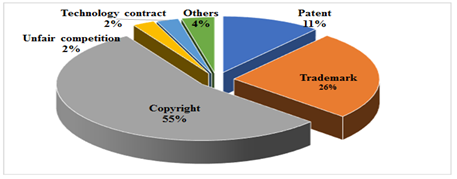
Chinese courts accepted 473,411 new first-instance civil IP cases in 2025, representing a 5.22% year-on-year increase. Copyright disputes continued to dominate the civil IP docket, with 259,248 newly accepted cases, accounting for 54.76% of the total. Trademark cases ranked second at 121,133 cases (25.59%), followed by patent disputes at 52,177 cases (11.02%), technology contract disputes at 11,782 cases (2.49%), unfair competition cases at 11,684 cases (2.47%), and other IP-related cases at 17,387 cases (3.67%) (See Tables 1, 2, and 3). Among these categories, trademark litigation was the only area to record a decline, with newly accepted cases decreasing by 3.03%. It should be noted that patent cases include cases involving invention patents, utility model patents, and design patents.
At the appellate level, the total number of second-instance civil IP cases was 24,515, a decrease of 19.59% compared with the previous year. As shown in Table 1, the number of second-instance cases has shown a consistent downward trend since 2021.
Table 1. Number of Civil IP Cases Accepted by People's Courts (2021–2025)
|
Instance/ Category |
2021 |
2022 |
2023 |
2024 |
2025 |
YoY Change |
|
|
Civil First-Instance |
550,263 |
438,480 |
462,173 |
449,923 |
473,411 |
5.22% |
|
|
Instance/Category Category |
Patent |
31,618 |
38,970 |
44,711 |
44,255 |
52,177 |
17.90% |
|
Trademark |
124,716 |
112,474 |
131,429 |
124,918 |
121,133 |
-3.03% |
|
|
Copyright |
360,489 |
255,693 |
251,687 |
247,149 |
259,248 |
4.90% |
|
|
Unfair competition |
8,419 |
9,388 |
10,230 |
10,567 |
11,684 |
10.57% |
|
|
Technology contract |
4,015 |
4,233 |
6,492 |
8,320 |
11,782 |
41.61% |
|
|
Others |
21,006 |
17,717 |
17,627 |
14,714 |
17,398 |
18.17% |
|
|
Civil Second-Instance |
49,084 |
46,524 |
37,214 |
30,486 |
24,515 |
-19.59% |
|
Table 2. Trend in First-Instance Civil IP Cases Accepted (2021–2025)
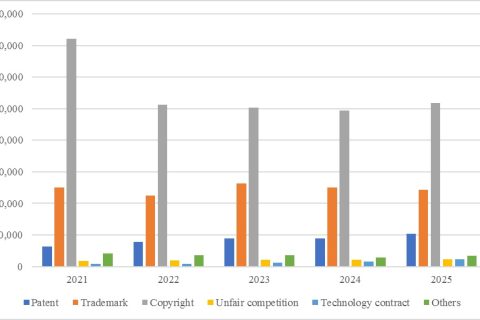
Table 3. Breakdown of First-Instance Civil IP Cases by Category (2025)
(2) Administrative Litigation Statistics
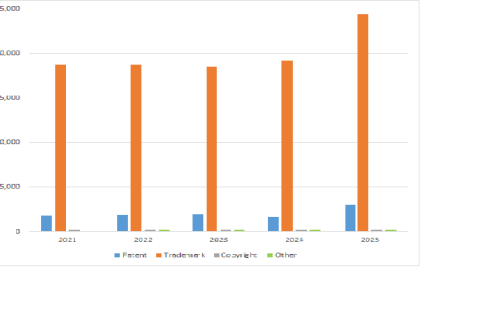
Chinese courts accepted a total of 27,451 new first-instance administrative IP cases in 2025, marking a year-on-year increase of 31.67%. Trademark cases remained the largest category, with 24,334 cases, accounting for 88.65% of all newly accepted cases. Patent cases totaled 3,070, representing 11.18%. Copyright administrative cases increased by 200% to 27 cases, while other types of administrative IP cases decreased by 35.48% to 20 cases.
Meanwhile, the total number of newly accepted second-instance administrative IP cases was 11,097, representing a year-on-year decrease of 4.88% (see Tables 4 and 5).
Table 4. Number of Administrative IP Cases Accepted by People's Courts (2021–2025)
|
Instance/Category |
2021 |
2022 |
2023 |
2024 |
2025 |
YoY Change |
|
|
Administrative First-Instance |
20,563 |
20,634 |
20,583 |
20,849 |
27,451 |
31.67% |
|
|
Category |
Patent |
1,810 |
1,876 |
1,990 |
1,679 |
3,070 |
82.85% |
|
Trademark |
18,734 |
18,738 |
18,558 |
19,130 |
24,334 |
27.20% |
|
|
Copyright |
19 |
12 |
11 |
9 |
27 |
200% |
|
|
Others |
0 |
8 |
24 |
31 |
20 |
-35.48% |
|
|
Administrative Second-Instance |
8,215 |
5,897 |
10,053 |
11,666 |
11,097 |
-4.88% |
|
Table 5. Trend in First-Instance Administrative IP Cases Accepted (2021–2025)
(3) Criminal Litigation Statistics
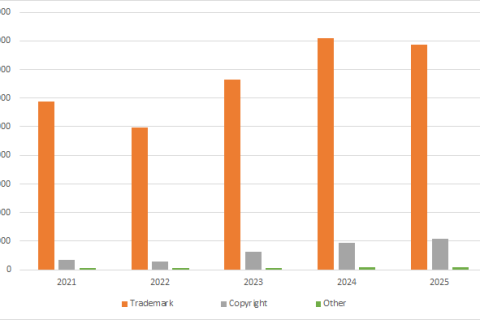
Chinese courts accepted 9,018 new first-instance criminal IP cases in 2025, a decrease of 1.12% compared with the previous year. Among the major categories, trademark cases declined by 2.69% to 7,862 cases, while other criminal IP cases, including patent cases, decreased by 17.65% to 85 cases. In contrast, copyright criminal cases recorded a significant increase of 14.18% to 1,071 cases. At the appellate level, the number of second-instance criminal IP cases was 1,153, representing a year-on-year increase of 3.69%.
Table 6. Number of Criminal IP Cases Accepted by People's Courts (2021–2025)
|
Instance/Category |
2021 |
2022 |
2023 |
2024 |
2025 |
YoY Change |
|
|
Criminal First-Instance |
6,276 |
5,336 |
7,335 |
9,120 |
9,018 |
-1.12% |
|
|
Category |
Trademark |
5,869 |
4,971 |
6,634 |
8,079 |
7,862 |
-2.69% |
|
Copyright |
333 |
304 |
627 |
938 |
1,071 |
14.18% |
|
|
Others |
74 |
61 |
74 |
103 |
85 |
-17.65% |
|
|
Criminal Second-Instance |
1,050 |
979 |
956 |
1,112 |
1,153 |
3.69% |
|
Table 7. Trend in First-Instance Criminal IP Cases Accepted Courts (2021–2025)
- Intellectual Property Protection through the Administrative Route
(1) Enforcement of Patent Rights via Administrative Route
In 2025, Market Regulation Administration nationwide investigated and handled 881 patent-related violations. As part of nationwide campaigns against infringing and counterfeit goods, products valued at RMB 432 million were destroyed, covering over 200 product categories and totaling 3,683 tons.
In addition, Intellectual Property Administration nationwide accepted 9,520 patent infringement disputes and concluded 9,341 cases during the year.
(2) Enforcement of Trademark Rights via Administrative Route
In 2025, Market Regulation Administration nationwide investigated approximately 36,000 trademark-related violations. Among these, 1,128 cases involving suspected criminal conduct were referred to judicial authorities for criminal prosecution.
- Observations
The 2025 statistics reveal growth in first-instance civil and administrative IP cases and a decline in first-instance criminal IP cases over the past year. In addition, 59 bad-faith agencies and practitioners were placed on the list of entities committing serious illegal violations, reflecting continued efforts to strengthen enforcement against unlawful and improper agency practices.
A review of the five-year litigation trend shows a steady increase in first-instance cases involving unfair competition and technology contract disputes since 2021. This trend reflects a rise in unfair competition and trade secret infringement activities. In response, legislative and judicial measures have been strengthened, including amendments to China's Anti-Unfair Competition Law in 2025.
At the same time, administrative enforcement against IP infringement continues to intensify. In particular, serious trademark-related violations that may constitute criminal offenses are increasingly being transferred to judicial bodies for criminal prosecution following initial administrative investigation and enforcement.
For rights holders, these developments underscore the importance of adopting a multi-faceted enforcement strategy. Beyond judicial remedies, rights holders should leverage the distinctive advantages of administrative enforcement and, where appropriate, consider criminal enforcement under the Criminal Law.